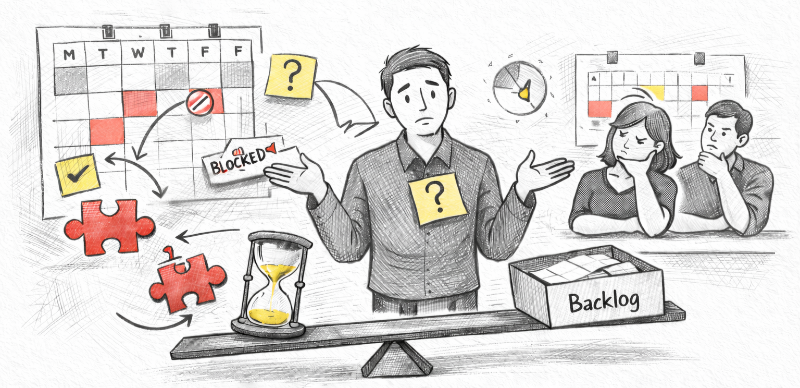
An open calendar slot does not make an assignment workable. Someone may be free next Tuesday and still be the wrong fit, tied up at a key handoff on another project, or needed later than the schedule shows.
Good scheduling starts with availability, but it has to account for skills, priorities, dependencies, and the normal changes that happen after planning.
The usual scheduling process is reasonable until the work is real
Most teams are not careless about scheduling. They define objectives, gather availability, create a draft plan, circulate it for feedback, and publish the version everyone should follow. Shared calendars, planning boards, spreadsheets, and team rituals all help keep the work visible.
That process can work well for meetings and short tasks. It gets harder when the work spans sprints, releases, discovery cycles, implementation windows, and several teams with different constraints.
The default team scheduling toolkit
Project managers and product leaders usually reach for practical, familiar approaches first. They ask team members when they are available. They block out holidays, known leave, and recurring meetings. They map people to workstreams, publish a schedule, and ask people to flag conflicts before work begins.
Mature teams add more structure. They define scheduling goals, separate deep work from collaboration time, reserve buffers around handoffs, and review the schedule at the end of each planning cycle. They document assumptions so changes can be discussed early instead of discovered through missed dates.
These are good habits. They make the plan easier to discuss. The weak point is that one planner is still trying to hold too many moving parts in their head, often across several tools.
Availability is not the same as readiness
Availability answers one question: can this person be assigned during this period? A workable project schedule needs several more answers.
- Is this the right person, or just an available person?
- Is another project already counting on the same person?
- Does this work need to happen before or after another workstream?
- How much capacity is left after leave, part-time hours, reviews, and team ceremonies?
- If capacity is short, which work should move first?
When these questions sit outside the schedule, conflicts tend to appear late. The plan looks tidy because every task has an owner and every owner has a calendar slot. Then delivery starts and the team discovers that two high-priority initiatives need the same specialist, or that discovery work was scheduled after the build work that depends on it.
Manual safeguards reduce risk, but they do not remove the guesswork
Teams often add safeguards: color-coded capacity views, weekly resource meetings, manager approvals, priority rules, and buffers between milestones. These safeguards help because they force tradeoffs into the open before the schedule is treated as final.
They also create maintenance work. Every leave update, scope change, project delay, and priority shift has to be translated back into the plan. If the schedule lives in multiple places, small changes can create version confusion. If it lives with one planner, that person becomes the bottleneck.
A schedule is only trustworthy if it stays connected to the constraints it was built from.
How Workable builds schedules around real constraints
Workable is designed for plans that need to be checked against constraints, not just arranged on a timeline. You define the work, the required skills, the people who can do it, their availability, project priorities, holidays, and timing. Workable uses those inputs to build a feasible schedule where one exists.
This matters when work changes. Instead of manually checking every assignment after a date, scope, or priority shift, you can generate another schedule and see whether the plan still holds. If it does not, Workable shows what is blocking delivery, such as a missing skill, a capacity shortfall, or conflicting requirements.
Workable also fits the way product and project teams plan. You can work with sprints, longer initiatives, or custom timeframes instead of forcing every team into one planning rhythm. That is useful when discovery, delivery, release, and support work overlap.