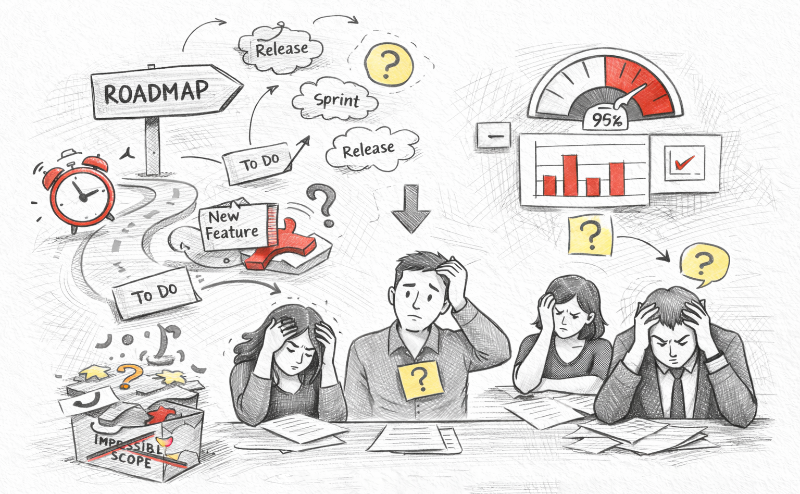
Product roadmaps can look confident while leaving the hardest question unanswered: can the team deliver this mix of work with the people, skills, and time available?
When roadmap commitments are made before capacity is tested, planning turns into cleanup. The team has to absorb too much scope, move dates, or explain later why the plan was never workable.
Prioritization is not finished until the work is scheduled
Product teams are often good at ranking opportunities. They collect customer feedback, define themes, estimate effort, sequence work, and make tradeoffs. That creates focus, but it does not automatically create a delivery plan the team can execute.
A roadmap needs to pass a capacity test. The question is not only which initiatives matter most. It is whether the team has the right people available at the right time, without breaking other commitments already in motion.
The standard roadmap planning process
The common planning process is familiar. Teams define goals, collect candidate initiatives, estimate effort, group work into releases or quarters, and use priority criteria to decide what should come first. Leaders review the plan, make changes, and share the roadmap.
Capacity planning is often added through a spreadsheet or a planning board. Planners convert estimates into person-weeks, subtract holidays and known leave, and compare demand against the rough capacity of each team. If demand is too high, they defer lower-priority work or ask whether more people can be added.
This is a reasonable starting point. It makes demand visible and gives teams a language for tradeoffs. It also leaves a large gap between a high-level capacity model and the sequence of work the team has to execute.
Where roadmap plans become wishful thinking
Roadmaps fail when they treat capacity as a pooled average. Ten available people are not ten interchangeable people. A project may need specific product, design, data, engineering, or operational skills at specific moments. If those people are already committed elsewhere, the plan cannot be solved by total capacity alone.
The risk grows when the same specialists support multiple initiatives. A technical lead, designer, analyst, or subject matter expert can become a hidden constraint across the whole portfolio. Each individual project plan may look reasonable, while the combined roadmap asks the same person to be in two places at once.
Another common problem is the order of commitment. Teams approve the roadmap, announce dates, and only then discover that the work cannot fit. At that point, every correction feels like slippage instead of a normal planning decision.
The earlier a team tests capacity, the easier it is to discuss scope, sequence, and timing.
Manual scenario planning is valuable but slow
Many organizations solve this with scenario planning workshops. They create a base case, a reduced-scope option, an aggressive option, and sometimes a delayed-start option. Each scenario is reviewed against team capacity and then discussed by product, delivery, and leadership stakeholders.
These sessions are useful because they force tradeoffs into the open. They also create a lot of manual work. Each change to timing, priority, or scope requires someone to recalculate assignments, check skill coverage, and update the story behind the plan.
Manual scenario planning often slows down exactly when teams need fast answers. A customer deadline moves. A strategic project becomes urgent. A key person takes leave. A dependency shifts. The team needs to know what changes, what moves, and whether the new plan is still feasible.
How Workable helps teams compare roadmap options before committing
Workable turns roadmap planning into a feasibility check before the roadmap becomes a public promise. You define the initiatives, timing, required skills, available people, and priorities. Workable then builds a schedule that fits those constraints, or shows why it cannot.
This makes scenario planning faster and more concrete. You can adjust scope, timelines, or priorities and generate a new version of the plan. Workable shows how each option affects capacity and delivery so teams can decide what to keep, move, or defer.
When there is not enough capacity, Workable helps protect the most important work. Lower-priority work can be pushed out instead of quietly overloading the team. When a plan is blocked by missing skills or conflicting requirements, Workable surfaces the issue so leaders can fix the right problem.